
The Two Paths of Growing Up Separation vs. Individuation
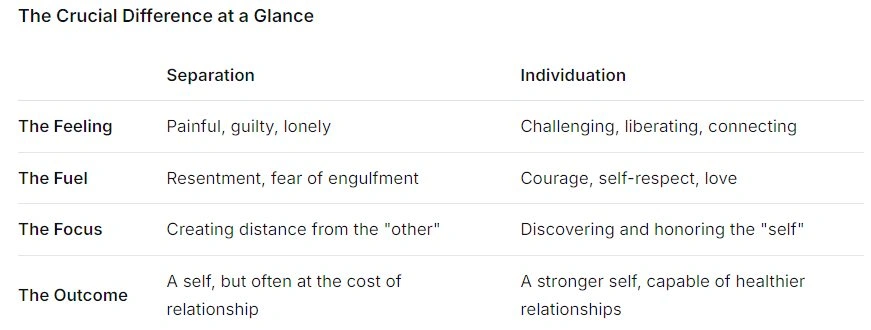
We all reach a point where we need to find our own voice, our own way, our own self. But how we go about it makes all the difference. Many of us confuse two very different journeys: Separation and Individuation.
They might look similar on the surface, but they feel worlds apart in the heart.
The Path of Separation: "I Have to Leave You to Be Me."
Separation is a process built on distance. It operates on a painful but common belief: “For me to be an individual, I must cut ties, create hard boundaries, and essentially, leave you behind.”
This path often feels like a rupture.
What Separation Feels Like:
- A heavy sense of guilt and disloyalty. You feel you’re betraying your family, your partner, or your friends by wanting something different.
- It’s fueled by anger or resentment, because pushing away often feels easier than navigating complex closeness.
- The primary emotion is loss. You gain independence, but it comes at the cost of connection, leaving a hollow, lonely feeling.
- The mantra is: “I am me, and that means I cannot be with you.”
Separation is a painful but sometimes necessary first step out of an enmeshed or unhealthy situation. Yet, it often just creates a new kind of prison—one of isolation.
The Path of Individuation: "I Can Discover Me While Staying Connected to You."
Individuation is a process built on differentiation. It’s the courageous work of discovering and owning who you are within the context of your relationships. The goal isn’t to leave, but to learn how to stand firm while staying connected.
This path feels like growth.
What Individuation Feels Like:
- A sense of clarity and self-discovery. You explore your values, passions, and beliefs without the immediate fear of losing love.
- It’s fueled by courage and self-respect, not resentment. You can say, “This is what I need,” without having to say, “You are wrong for what you need.”
- The primary emotion is empowerment. You feel more “yourself” and paradoxically, more capable of genuine connection because you aren’t afraid of being swallowed up.
- The mantra is: “I am me, and you are you, and we can still be us.”
Individuation allows for a continuous thread of love and respect, even through disagreement and change. The connection evolves; it doesn’t sever.
What Individuation Feels Like:
You might read this and wonder, “Do we ever become so solid that we’re fully individuated?”
The answer is no, and that’s the point. Individuation isn’t a destination you reach; it’s a lifelong direction of travel. It’s the ongoing practice of being in relationship with yourself and others with increasing authenticity.
Think of it not as building an impenetrable fortress, but as developing a flexible core—like a bamboo tree that bends in a storm but doesn’t break because its roots are deep.
You know you're on the path when you:
- Can hold complex “and” statements: “I love them AND I disagree with them.”
- Find your self-worth is internally referenced, not dictated by others’ opinions.
- Choose the temporary discomfort of growth over the permanent pain of self-betrayal.
- Feel your relationships are conscious choices, not obligations.
- Can be deeply connected to someone without feeling like you’re losing yourself.
The goal is to become a lifelong learner of your own soul. You know you’re “there” not when the work stops, but when the work itself becomes a source of strength.
If you’re on the path of separation, feeling that painful tug of guilt, know that it’s a valid and often protective step. But don’t stop there. The ultimate goal is to build a home within yourself and still welcome the people you love.
#Individuation #Separation #PersonalGrowth #HealthyRelationships #SelfDiscovery #LifelongGrowth #MentalHealthAwareness #FindingYourself
Recent Blogs You Might Like