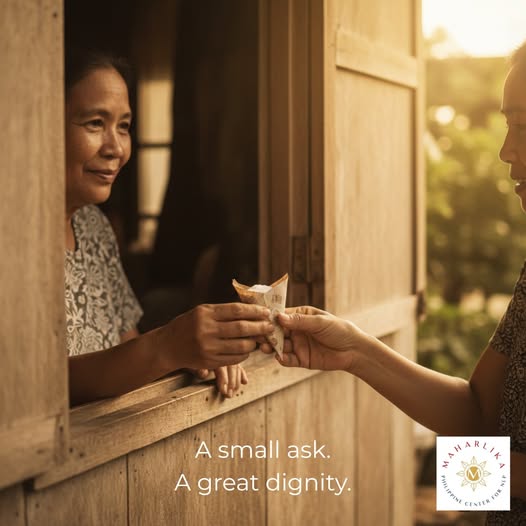
A small ask. A great dignity.
The neighbor, who had less, would often come to borrow small things—a little rice, some oil. The mother always gave gladly.
This mother had enough—a full pantry, a secure home. Yet sometimes, she would send her child next door to ask, “Puwede po pahiram ng kaunting asin?“
Her child, confused, finally asked why. They had plenty.
Her answer was soft. She did it, she said, so her neighbor could have the dignity of giving, too.
I see this story as a gentle mirror held up to our own Filipino spirit. We know how to give. Perhaps we know it too well—a generosity born from deep empathy, maybe even from a history of intimately understanding how it is to be in need. Our pagkawang-gawa often flows naturally from the heart, a beautiful response to the pains we’ve known and witnessed.
Yet, the wisdom of the story—and of Bert Hellinger’s Order of Balance—invites us to look at the other side of that beautiful coin.
Hellinger observed that in families and relationships, there is a silent, natural need for equilibrium between giving and taking. When the flow only goes one way, it can create an unseen weight. The one who is always giving can quietly grow weary, and the one who is always receiving can feel a heavy sense of utang na loob, a debt that diminishes rather than connects.
What that wise mother did was tend to this balance. Her request for salt was an act of profound respect. It was her way of receiving, so her neighbor could stand in the fullness of her own capacity to give. It quietly said, “I see you not just as someone I can help, but as someone who can also help me.”
For us, with our generous hearts, the lesson might be this: true healing and connection happen in the exchange. It is just as sacred to receive as it is to give. To allow others to give to us is not a weakness; it is an act of trust that completes the circle. It honors their strength and preserves our own.
It is a humble reminder that sometimes, the greatest gift we can offer—to our neighbor, to our family, to ourselves—is to create the space where we, too, can gracefully accept a little salt.
At Maharlika NLP, we often explore these unseen architectures of our relationships—the hidden dynamics that shape our sense of belonging, worth, and peace. This Order of Balance is one of the most beautiful and healing among them.
Recent Blogs You Might Like

It happens to everyone. Someone's words or actions land in a way that makes you feel small. Overlooked. Dismissed. Disrespected....

-From "Why" to "How": The NLP Shift That Drives Real Change- Neuro-Linguistic Programming (NLP) emphasizes that asking "How?" is far...

The belief that genius is innate is perhaps the greatest limitation to human potential. Neuro-Linguistic Programming (NLP) shatters this myth...