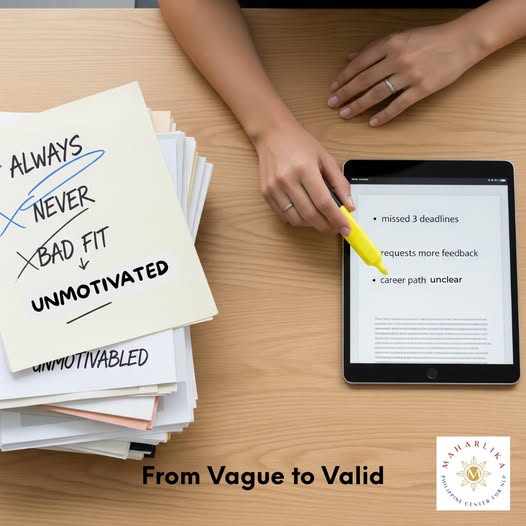
Its goal is simple: to identify and challenge the vague language we all use (linguists call these “deletions,” “distortions,” and “generalizations”) to uncover the specific, verifiable information underneath.
Why the Meta Model is an HR Game-Changer
Vague language is the primary fuel for misunderstanding, misdiagnosed problems, and ineffective solutions. The Meta Model equips you to:
• Conduct sharper, fairer investigations.
• Write clearer, more actionable policies.
• Facilitate more effective performance and development conversations.
• Gather accurate data to inform strategic decisions.
Your New HR Toolkit: 3 Meta Model Superpowers
Here’s how to apply it in your most critical HR functions.
1. Challenge Generalizations: Words like “always,” “never,” “everyone.”
The Vague Statement: I never get any feedback.”
The Meta Model Question: “What specifically would you like feedback on? Can you tell me about the last time you expected feedback but didn’t receive it?”
The HR impact: Moves from a general complaint to a specific, addressable event. You might discover a manager skipped a scheduled one-to-one, which is a solvable problem.
2. Recover Deleted Information: When key details are missing.
The Vague Statement: “They’re not a good fit for the culture.”
The Meta Model Questions: “What, specifically, are they doing that leads you to say that? Compared to what ideal behavior?”
The HR impact: Uncovers the tangible behaviors behind a subjective judgment. This is crucial for defending against wrongful termination claims and for providing the employee with constructive, actionable feedback.
3. Clarify Distortions: When assumptions are stated as facts.
The Vague Statement: “She must not care about the project; she left at 5 PM.”
The Meta Model Questions: “How do you know she doesn’t care? What evidence are you using to make that judgment?”
The HR impact: Separates observable facts (she left at 5) from harmful mind-reading and assumptions. This prevents gossip and addresses the real issue, which might be about project deadlines and communication, not effort.
A Note of Balance: Wield This Power Wisely
The Meta Model is incredibly powerful, and with that power comes responsibility. It must be used with empathy and intention, not as a weapon.
 Don’t Be an Interrogator: The goal is understanding, not cornering someone. Your tone must be curious and helpful, not accusatory.
 Do Pace the Person: Acknowledge their emotion first. “I hear this is really frustrating for you. To make sure I understand correctly, can you give me a specific example?” Don’t Use It in Every Casual Conversation: You’ll sound like a robot. Deploy it strategically in situations where precision is critical. Do Use It to Empower: Frame it as a way to help you both solve the problem together. “I want to make sure I can advocate for you properly, so I need to understand the specifics.”
For HR Directors, the Meta Model isn’t about manipulation; it’s about clarity, fairness, and effective problem-solving. It’s the antidote to ambiguity and the foundation for building a more transparent, accountable, and ultimately more functional organization.