

"She's All Rght" Seeing the child, not just the behavior
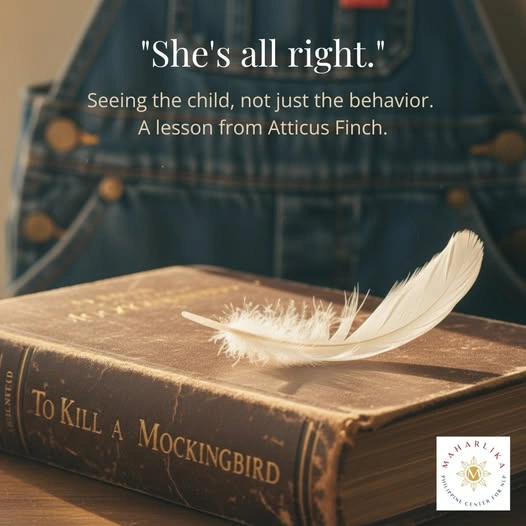
That Time Atticus Finch Gave a Masterclass in NLP
We all know Atticus Finch as the pillar of morality in Harper Lee’s To Kill a Mockingbird. We admire him for his courage in the courtroom, but some of his wisest parenting moments happen quietly at home.
Remember the scene where his sister, Aunt Alexandra, moves in and is horrified by Scout’s unladylike behavior and language? She confronts Atticus, insisting, “You’ve got to do something about her.”
Atticus’s response? “I wouldn’t worry about her,” he said. “She’s all right.” And later, “She’ll have to learn soon enough, anyway… Let her go for now.”
While Aunt Alexandra sees a “problem that needs fixing,” Atticus sees the whole child. He isn’t being neglectful; he’s being perceptive. He understands that Scout’s rough edges are behaviors—responses to the stress of school, judgment from her aunt, and the town’s prejudice. They are a phase, a suit of armor she’s wearing.
He never for a second believes that these temporary behaviors are who she is.
And this is where classic literature beautifully intersects with a core principle of Neuro-Linguistic Programming (NLP): People are not their behaviors.
What Does "People Are Not Their Behaviors" Really Mean?
This NLP presupposition is a game-changer for parents, leaders, and anyone in a relationship. It means:
- Separate the Person from the Action: A child who is acting out is not a “bad kid.” They are a whole person who is behaving in a way we find challenging, likely because of an unmet need, a big feeling they can’t process, or a skill they haven’t learned yet.
- It Creates Space for Empathy: When we stop labeling the person (“she’s disrespectful,” “he’s lazy”), we can get curious about the behavior. Why is this happening? What is this communication really about? Atticus knew Scout’s cussing wasn’t about a corrupted soul; it was about her grappling with a world that felt unfair.
- It Fosters Growth and Change: If you identify a person as their behavior, change feels impossible. But if a behavior is just something a person is doing, then it can be unlearned or replaced. By not shaming Scout, Atticus gave her the emotional safety to outgrow the phase naturally.
The Modern-Day Application
How many of us get into conflicts because we confuse a person’s actions for their character?
- Your employee misses a deadline, and you think, “They’re irresponsible,” instead of asking, “What obstacle are they facing?”
- Your partner snaps at you, and you think, “They’re a jerk,” instead of wondering, “What stress are they under?”
Atticus’s lesson is timeless. The next time you’re frustrated by someone’s behavior—especially a child’s—pause. Take a leaf out of Atticus Finch’s book. See the behavior as a signal, not an identity.
Choose to believe in the good, whole person beneath the surface, who is simply doing the best they can with the tools they have available at that moment.
It’s the most powerful way to build trust and foster real, lasting change.
#ToKillAMockingbird #AtticusFinch #NLP #NeuroLinguisticProgramming #ParentingWisdom #MindfulParenting #PersonalGrowth #Communication #Empathy
Recent Blogs You Might Like